In the traditional B2B sales funnel, the approach was often “spray and pray.” Marketers would blast generic papers and cold emails to thousands of prospects, hoping that a 1% conversion rate would sustain their pipeline. But as we move through 2026, that model hasn’t just slowed down—it has completely broken.
The reason? Buyer Fatigue. Professional decision-makers are bombarded with more automated noise than ever before. To cut through the static, B2B leaders are turning to the only thing AI cannot fake without deep data: Hyper-Personalization.
The Death of the “Generic” B2B Funnel
In 2026, B2B buyers expect a B2C experience. They want the platforms they use at work to understand their needs as intuitively as Netflix or Amazon does. According to recent industry shifts, 73% of B2B buyers now state they only engage with marketing personalized to their specific industry challenges and job role.
AI has shifted the focus from Lead Quantity to Lead Intelligence. Instead of a broad net, AI allows companies to use a “harpoon” approach—targeting high-value accounts with surgical precision.
- Key Shift: From Segments to Individuals
- Old Way: Targeting “Marketing Managers in Tech.
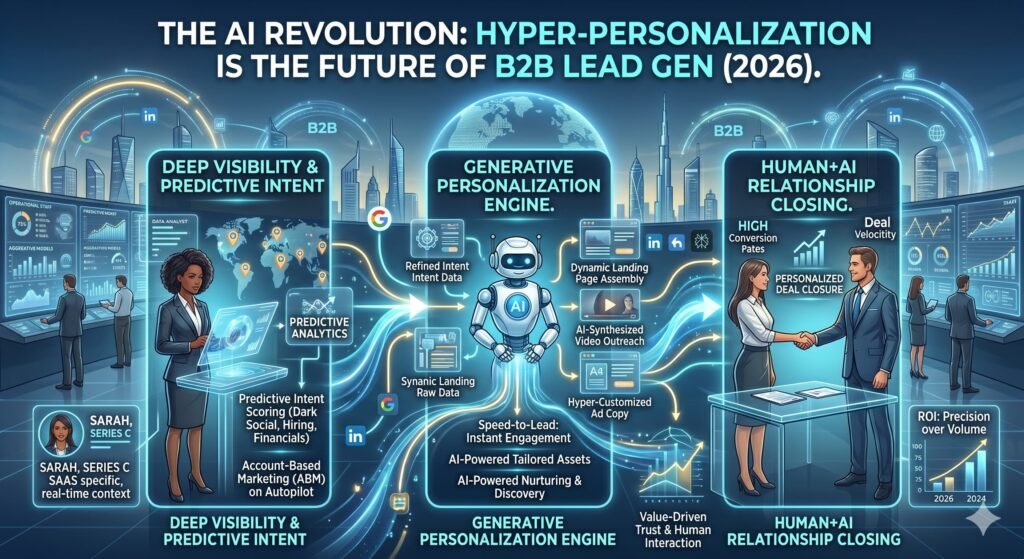
AI Way: Targeting “Sarah, a Marketing Lead at a Series C SaaS company, who just published a post about scaling her SEO team and is currently using a competitor’s tool that expires in 3 months.
Predictive Analytics: Knowing the Need Before the Lead Does
The true power of the AI revolution lies in Predictive Intent Data. AI models now analyze billions of data points—from hiring trends and financial reports to “dark social” signals—to predict which companies are in a buying window.
By the time a prospect fills out a “Contact Us” form, they are already 70% through the buying journey. AI allows B2B teams to enter that journey at 10%, providing value-driven content exactly when the problem first arises within the prospect’s organization.
Generative AI as a “Personalization Engine
Generative AI (GenAI) has evolved far beyond simple chatbots. In 2026, it serves as the backbone of high-converting outreach:
Dynamic Landing Pages: When a prospect clicks a link, the website reconfigures itself in real-time. The case studies, hero images, and testimonials shift to match the prospect’s specific industry.
AI-Synthesized Video Outreach: Sales reps can now use AI to create personalized video messages at scale, addressing the prospect by name and referencing their specific company goals without recording 500 individual clips.
Hyper-Customized Ad Copy: Meta and LinkedIn ads now use “fluid creative,” where the AI tweaks the value proposition based on the viewer’s specific professional history.
The Rise of “AEO” (Answer Engine Optimization) in B2B
As a digital professional, you know that SEO is changing. In 2026, B2B buyers aren’t just scrolling through blue links on Google; they are asking AI assistants like Gemini or Perplexity for recommendations.
To generate leads that close, your content must be optimized for Answer Engines. This means moving away from keyword stuffing and toward Semantic Authority. Your content must answer the specific, complex “How-to” and “Why” questions that B2B decision-makers ask their AI assistants during the research phase.
Account-Based Marketing (ABM) on Autopilot
Scaling ABM used to be impossible because it required too much manual effort. AI has changed the math.
- Automated Account Research: AI tools can scan a target account’s annual report, identify their “Pain Points,” and summarize them for your sales team in seconds.
- Multichannel Orchestration: If a target account engages with a LinkedIn ad, the AI can automatically trigger a personalized direct mail gift or a targeted email from the CEO.
- Real-Time Qualification: AI agents now handle the initial “discovery call” via chat, qualifying the budget and authority before a human salesperson ever gets involved.
Overcoming the “Creepiness” Factor
With great data comes great responsibility. The challenge for B2B marketers in 2026 is balancing personalization with privacy.
To win trust, your personalization must be helpful, not haunting. Instead of saying, “I saw you were looking at our pricing page,” the AI-driven approach should be: “Since you’re scaling your infrastructure, I thought this guide on optimizing server costs for mid-sized firms might be useful.”
Trust is the currency of 2026. Using AI to be more helpful—rather than just more persistent—is what separates the market leaders from the spammers.
Conclusion: The Future belongs to the “Human+AI” Hybrid
The AI revolution isn’t about replacing the salesperson; it’s about removing the “robotic” tasks from the human so they can focus on building actual relationships.
In 2026, Personalization is the Future of B2B Lead Gen because it respects the buyer’s time. By delivering the right message, to the right person, at the exact moment of need, AI-driven practices are achieving conversion rates that were previously thought impossible.
Hi, this is a comment.
To get started with moderating, editing, and deleting comments, please visit the Comments screen in the dashboard.
Commenter avatars come from Gravatar.